Google Maps Proximity: Why You Only Rank on One Side of Town
Google measures distance from the searcher, not from your shop. Why you rank on one side of town and not the other, and what actually widens your reach.
ReplyOnTheFly Team
Content Team
Search your own keyword from behind the counter and you look great. Number one, maybe number two. Then a customer three neighborhoods over says they searched the exact same thing and you were nowhere.
Quick answer
Google Maps ranking proximity means Google measures distance from the searcher's location, not from any fixed point. There is no single ranking; there's a different one on every block. You rank strongest near your address and fade with distance, and how fast you fade depends on how strong your other signals are compared to whoever is closer. You can't move your pin, but you can widen the radius your profile carries, and you can find out exactly where it ends.
Neither result was wrong. You really are number one at your address, and you really are invisible across town. This post explains why both are true at once, and what to do about it.
There Is No Single Google Maps Ranking
Google says local results balance three things: relevance (how well your profile matches the search), distance (how close you are to the searcher), and prominence (how well-known and well-reviewed you are).
Relevance and prominence are properties of your business. They travel with you. Distance is not; it's recalculated for every single search, from wherever that person happens to be standing.
So when someone on the east side searches "sports bar," Google builds a ranking for the east side. Someone on the west side gets a different ranking a second later. You could be first in one and tenth in the other, at the same moment, for the same words.
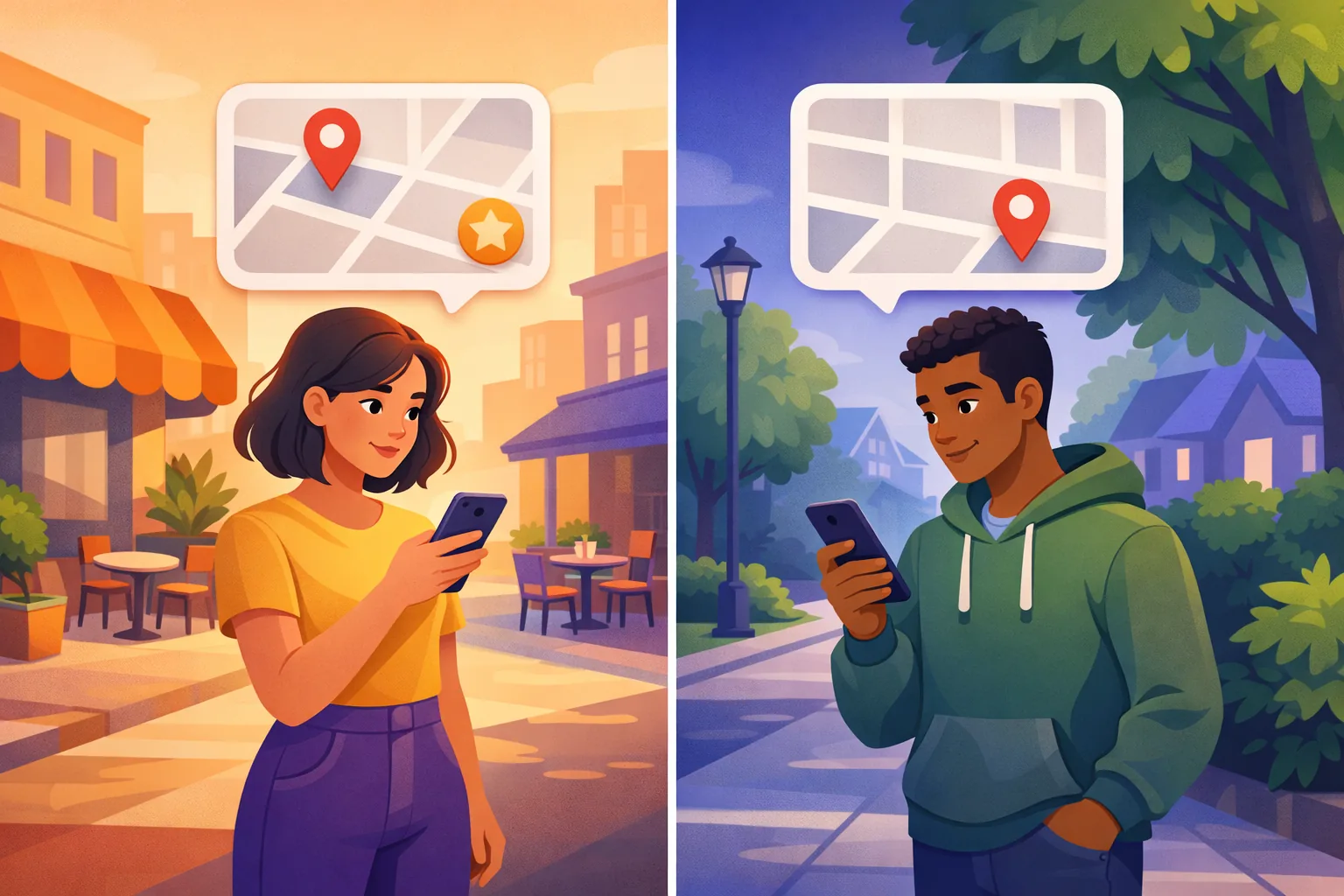
This is why checking your rank from your own shop tells you almost nothing. You're standing on the one spot on the map where your distance signal is perfect. Every step a searcher takes away from you hands a little of that advantage to someone else.
Think of your visibility as a shape on the map, not a number. Strong at the center, fading at the edges, dented wherever a competitor sits.
How Heavy Is Proximity, Really?
Heavy. In Whitespark's 2026 survey of 47 local SEO experts, proximity came out as the most heavily weighted factor in map rankings. It's the reason a mediocre profile two blocks from the searcher can beat an excellent one two miles away.
But it isn't the same weight in every industry. A machine-learning study of 7,718 businesses found proximity mattering most for home services, where it carried roughly 42% of the ranking outcome, and for restaurants at around 30%. For dental and healthcare, reviews mattered more than distance.
That makes sense when you think like a searcher. Nobody drives across town for a burrito, but plenty of people will for the dentist their neighbors rave about.
What this means for you
If you're a plumber or a pizza place, proximity is most of the game and your radius is the metric to obsess over. If you're a dentist, a vet, or a lawyer, your reviews can carry you into neighborhoods your address never could.
Find Out Where Your Radius Actually Ends
Before you spend a dollar or an hour on local SEO, you should know the shape of your visibility. Where do you win, where do you fade, and where does a competitor's dent begin?
Start with a free 7-neighborhood rank check. It scans your keyword from seven real points around your city and shows your position at each one, plus who outranks you there. Five minutes, no signup.

If what you find surprises you, and it usually does, a full rankings heatmap scans up to 30 neighborhoods around your location every week and tracks how the shape changes over time. It also scans both your broad keyword and its "near me" variant, because those two searches return different results and your radius for each can differ too.
The map you get back turns vague worry into a specific question. Not "why is my SEO bad," but "why do I lose the four neighborhoods north of the highway." That's a question you can actually work on.
What Doesn't Widen Your Radius
Plenty of advice promises to beat proximity. Most of it has been tested, and most of it fails. Save your time on these:
- Expanding your service area. For businesses with a physical address, a Whitespark controlled test found service-area changes produced no ranking movement whatsoever. Google ranks you from your verified address. Set your service area honestly so customers know where you'll travel, and expect nothing more from it. The same physics applies when the address is hidden; how service area businesses rank on Google Maps covers that case in full.
- Geotagging photos. Google strips location data from photos on upload. A 27-location test found no impact. This one is pure folklore.
- Stuffing city names into your description. Google has confirmed the description isn't used for ranking. Write it for customers.
- A page on your website for every suburb. City pages can win organic search results below the map, sometimes spectacularly, but their effect on map rankings is minimal. Worth doing for the right reasons, not this one.
The pattern in all four: you can't talk Google into believing you're somewhere you're not. The pin is the pin.
See Your Real Ranking Radius
ReplyOnTheFly's free rank check scans your keyword from 7 neighborhoods and shows exactly where you fade out.
Check My Rankings FreeWhat Actually Pushes Your Radius Outward
You can't reduce your distance to the searcher, but you can raise the other two signals until they carry you farther. Remember the trade-off: Google accepts a worse distance score when relevance and prominence are strong enough.
Fix your primary category first. Among the factors you control, the 2026 expert survey ranked primary category at the top. "Pizza restaurant" and "Italian restaurant" are different categories with different results, and the wrong pick shrinks your radius on every search that matters.
Check every service box you honestly can. Controlled testing has shown ranking movement within 24 to 72 hours of adding services to a profile. It's one of the only local SEO levers with a same-week effect, and most businesses have filled in a fraction of theirs.
Build review momentum, not just review count. A steady flow of recent, written reviews signals a business that's busy right now, and recency has climbed sharply in expert rankings of local factors. Prominence is the signal that travels farthest from your pin; it's how the dentist across town still reaches you.
Cover the hours people actually search. Google demotes closed businesses in map results. If your competitor's hours cover evenings and yours end at five, they inherit every after-hours search in town, including the ones near you.
Then patch everything else. Photos, attributes, description, questions. A free profile audit grades your profile against nine ranking factors in about 30 seconds and tells you which gaps are worth your next hour.
None of this moves your pin. All of it changes how far your pin reaches.
When Proximity Just Wins: Play the Map You Have
Sometimes you do everything right and the map still says no. The competitor is simply closer to more people than you are. At that point, strategy beats effort.
Own your side completely. Being solidly first across your half of town is worth more than being weakly fifth everywhere. Make sure no winnable neighborhood near you is leaking to a lazier profile.
Fight for the seams. Your heatmap will show contested zones where you and a competitor trade places. Those flip on small differences, a fresher review month, a fuller services list, so they're where profile work pays fastest.
Match keywords to geography. "Near me" searches lean harder on distance than broad searches do (our scan data puts the top 3 about 15% closer to the searcher). You may never win "near me" across town, while "emergency plumber" or "gluten free bakery" can travel much farther on relevance. Track both variants and spend effort where movement is possible.
If the market justifies it, add a real location. The only true fix for proximity is presence. A second verified location with its own address, phone, and review base resets the distance math for that side of town. It's a business decision, not an SEO trick, and it's what serious multi-location operators are actually doing when they seem to "rank everywhere."
For the full picture of every factor beyond proximity, our guide to ranking higher on Google Maps walks the whole checklist, and if one specific rival keeps beating you, start with why your competitor outranks you.
The Takeaway
You don't have one Google Maps ranking. You have a shape on the map: strong at your pin, fading with distance, bent by every competitor around you.
Proximity decides the center of that shape, and you can't change it. Relevance and prominence decide its size, and you can change those every week. Find the edge, work the seams, and stop grading yourself on the one search spot where you were always going to look good.
Frequently Asked Questions
Why do I rank first near my shop but nowhere else in town?
Because Google builds a fresh ranking for every search, measured from the searcher's location. Near your address, you win the distance signal by default. Farther away, that advantage transfers to whoever is closer, and your relevance and reputation have to carry the ranking on their own. If they can't, you fade out block by block. That fade is normal; the question is whether your visible radius covers the neighborhoods your customers actually live in.
Is proximity the most important Google Maps ranking factor?
It is the most heavily weighted single factor in most expert assessments, including Whitespark's 2026 survey of 47 local SEO practitioners. But its weight varies a lot by industry. A machine-learning study of 7,718 businesses found proximity mattering most for home services and restaurants, while for healthcare and dental, reviews carried more weight than distance. So how much proximity rules your market depends on what you do.
Does adding service areas to my profile expand where I rank?
No. For a business with a physical address, a Whitespark controlled test found that adding or expanding service areas produced no ranking movement at all. Google ranks you from your verified address regardless of the service area you draw. Service areas are worth setting accurately because they tell customers where you'll go, but they are a label, not a ranking lever.
How far from my address can I rank on Google Maps?
There is no fixed distance, because your radius is set by competition, not by Google policy. You rank outward until searchers are closer to a competitor who matches the search as well as you do. A rural service business can dominate for twenty miles; a downtown coffee shop might fade within ten blocks. The only way to know your real radius is to check your keyword from multiple points around town rather than from your own counter.
Can I outrank a business that is closer to the searcher?
Yes, regularly. Proximity is heavy but not absolute, and Google trades it off against relevance and prominence. A precise primary category, a fully checked services list, steady recent reviews, and hours that cover the search moment routinely beat a slightly closer competitor with a neglected profile. What no profile work can do is beat everyone everywhere, which is why picking the neighborhoods worth fighting for matters more than chasing a single number-one spot.
Know Exactly Where You Rank, Every Week
ReplyOnTheFly's Rankings Heatmap scans up to 30 real neighborhoods around your business and shows your visibility as a map, not a guess. Free plan includes a monthly scan.
Start Free - No Credit Card Required- Unlimited AI drafts
- 5 free one-click posts/month
- Works from your email inbox
Written by ReplyOnTheFly Team
Content Team
Free toolNo signup
See where you rank
Scan seven neighborhoods around your business and find out who is outranking you.
Check my rankingOr create a free account to automate replies
Related Articles

How to Rank Higher on Google Maps: 12 Proven Strategies
Learn 12 proven strategies to rank higher on Google Maps in 2026. Optimize your GBP, get more reviews, and dominate local search results.

Why Your Competitor Outranks You on Google Maps
Your competitor ranks higher on Google Maps and you can't see why. Here are the six real reasons, how to check each one, and how to close the gap.

How to Track Your Google Maps Ranking (Free & Paid Methods)
Learn how to track your Google Maps ranking with free and paid tools. Monitor your local search position across real neighborhoods to grow visibility.