How to Find Patterns in Hundreds of Customer Reviews
Once you have hundreds of reviews, the loudest one isn't the most common. Here's how to find patterns in customer reviews at scale, without reading every one.
ReplyOnTheFly Team
Content Team

When you had thirty reviews, you knew them by heart. Now you have four hundred, and the truth about your business is spread across all of them, in a language of small repeated details no single review spells out.
Quick answer
To find patterns in customer reviews at scale, stop reading them one at a time and start counting what repeats. Group mentions by meaning, not exact words, then sort by how often each theme appears, because the loudest review is rarely the most common one. The four patterns worth digging for are frequency clusters, co-occurring details, differences between customer segments or locations, and reviews whose text and star rating disagree. Past a few hundred reviews, or more than one location, a tool that reads and counts them all keeps the picture honest.
Here's what this guide covers:
- Why hundreds of reviews is a genuinely different problem than dozens
- The reason the loudest review misleads you
- The four patterns hiding in a large pile of reviews
- A by-hand method that works up to a point
- When to let software read every one
Why Hundreds of Reviews Is a Different Problem
At a couple dozen reviews, reading is enough. You hold the whole picture in your head and a pattern is obvious because there isn't much to hide behind.
Past a hundred, that stops working, and not because you got lazy. Two quiet biases take over. You remember the most recent reviews far better than the average one, and you remember the most extreme one best of all. So your sense of "what customers think" is really a sense of what the last angry person said last week.
The star average doesn't rescue you either. It is a single number sitting on top of hundreds of different experiences, and it barely moves. A profile can hold a steady 4.6 while the reasons behind it churn completely underneath.
So the job changes shape. It stops being "read my reviews" and becomes "measure my reviews": what repeats, how often, and among whom. That is what finding patterns actually means once the pile gets big.
The Loudest Review Is Rarely the Most Common
Here is the trap that catches almost every owner. One review is furious, detailed, and personal, so it burns itself into your memory and quietly becomes your to-do list. Meanwhile the thing forty people mentioned in one calm sentence each never registers as a problem at all.

Intensity and frequency are different measurements, and only one of them predicts what your next customer will experience. The furious outlier might be a genuine one-off. The forty quiet mentions of tight parking, a slow lunch rush, or a confusing booking step are the pattern, because they keep happening.
The discipline is simple to say and hard to do: count what repeats, not what stings. When you sort by how often something is named instead of how strongly it was said, your priority list reshuffles, usually away from the drama and toward the friction that is costing you customers every week.
The Four Patterns Worth Digging For
Not all patterns are the same shape. Once you're counting instead of reacting, four kinds are worth the effort, and each points at a fix the average hides.
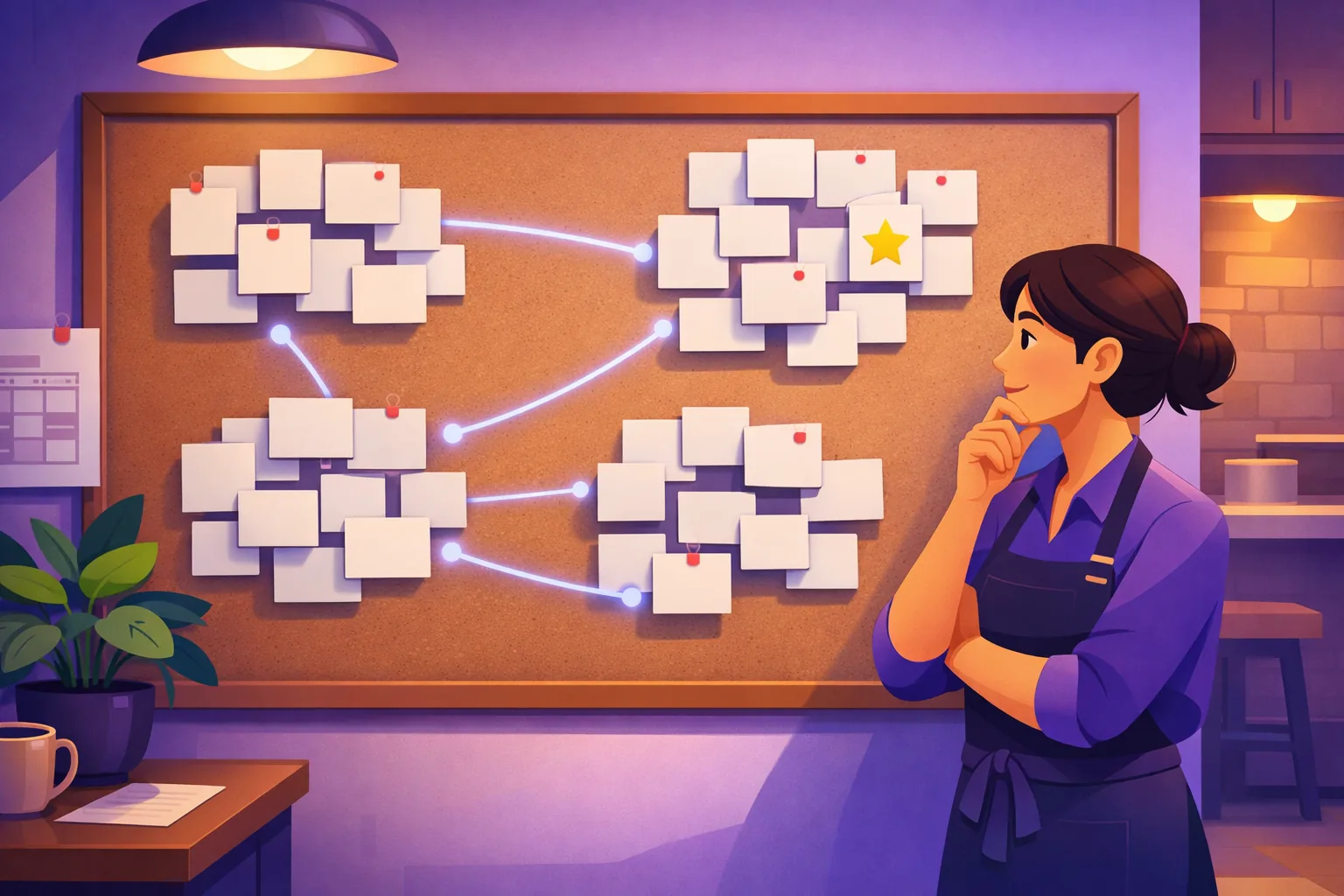
- Frequency clusters. The plainest pattern: what gets named most. Group synonyms together first, then rank. The theme at the top of that list is where your attention should go, whatever your gut was telling you.
- Co-occurrence. Two details that keep showing up in the same review. "Friendly staff, but slow" appearing again and again rarely means your staff is the problem. It usually means they are stretched too thin, which is a staffing fix, not a service one. What travels together tells you the cause.
- Segment and location patterns. Do first-time customers describe you the way regulars do? Does one branch collect the compliments and another the complaints? A pattern that only appears when you split the pile, by customer type or by location, is often the most actionable one you have.
- Rating-versus-text mismatches. Five-star reviews with a buried "only complaint is..." are free, specific advice from people who love you. Four-star reviews whose words read like pure praise are reviews you can sometimes win back to five. Both hide inside the average and neither shows up if you only watch the stars.
Don't tag by exact words
"Slow," "took forever," and "still waiting" are one pattern, not three. If you count exact phrases, real themes shatter into fragments and nothing crosses the threshold to look important. Always group by meaning first, then count.
A Method You Can Run by Hand
You do not need software to start. You need a repeatable way to turn a pile into a tally. It goes faster with every review in one sheet, so if yours are still trapped on your profile, start by exporting your Google reviews to a spreadsheet.

Here is the whole method:
- Sample if you must. If the pile is huge, read your most recent hundred rather than all four hundred. A pattern that is real will show up in a good-sized sample.
- Tag each review by meaning. As you read, jot the details that repeat: a place (patio, parking), a moment (checkout, the wait), a person (a named staffer), a feeling (rushed, welcomed). Merge synonyms as you go.
- Tally, then sort. Count how many reviews carry each tag and rank them. The order will surprise you, because it is frequency, not memory.
- Note the pairs. Whenever two tags show up in the same review, mark it. Those pairs are your co-occurrence patterns.
Give this a Saturday and you'll learn more about your business than a quarter of gut feel. But be honest about where it breaks: it stops being reliable somewhere past a few hundred reviews, and it falls apart entirely across multiple locations, because no one can hold several piles in their head at once without the same recency and intensity biases creeping back in.
Skip the tally sheet
ReplyOnTheFly's Review Insights reads every review, groups them by meaning, and ranks the patterns for you, free on every plan.
Start freeWhen to Let Software Read Every One
The by-hand method has a ceiling, and it's lower than most owners think. The moment you can't remember whether "parking" came up ten times or forty, you've stopped measuring and started guessing again.

This is the specific job AI review insights do well. They read every review without getting tired or biased, group "slow," "took forever," and "still waiting" into a single theme, count how often each one appears, and show whether it is rising or fading, with the actual reviews attached so you can judge the pattern yourself instead of trusting a chart.
For more than one location it is the only honest option. Pooling every branch's reviews surfaces the pattern that hides in the combined pile, and comparing branch against branch tells you whether a problem is company-wide or one manager's shift. You can see the themes across all your reviews and drill from any pattern straight into the words behind it.
When a pattern turns out to be a recurring complaint, you'll be replying to a lot of similar reviews at once. The free review response generator drafts each one in your voice so acting on the pattern doesn't mean an afternoon of writing. And when you want the fuller discipline, what to measure and why, our guide to Google review analytics covers it end to end.
The same counting instinct works on profiles that aren't yours. What your competitors' reviews can teach you applies this method across the street, where every repeated complaint is a gap you can fill.
The pattern was always in there. Finding it is just deciding to count what repeats instead of remembering what shouted.
Frequently Asked Questions
How do I find patterns in hundreds of customer reviews?
Stop reading them one at a time and start counting what repeats. Tag each mention by meaning rather than exact words, so slow, took forever, and still waiting all land in the same bucket, then sort the buckets by how often they appear. The pattern is whatever shows up most, not whatever stung the most. Once the volume is past what you can hold in your head, usually a few hundred reviews or more than one location, a tool that groups and counts for you is the only way to keep it honest.
Why isn't the loudest review the most important one?
Because memory rewards intensity, not frequency. One furious one-star review lodges in your head while forty calm mentions of tight parking blur together, so you end up fixing the rare drama and missing the common friction. Patterns are about how often something is named across many reviews, not how angry any single reviewer was. Count first, react second, and the quiet repeated complaint usually turns out to matter more than the loud outlier.
How many reviews do I need before a pattern is trustworthy?
A pattern is repetition, so the test is the same specific point named by three to five different people, not one person saying it forcefully. With a few dozen reviews you can eyeball that. With hundreds, lean on frequency counts instead of impressions, because at that scale you no longer remember the most common review, you remember the most recent and the most extreme one. If a theme holds its share as more reviews arrive, it is real.
What kinds of patterns should I look for in reviews?
Four are worth the effort. Frequency clusters: what gets named most often. Co-occurrence: two things mentioned together, like friendly staff and slow service, which usually means understaffed rather than unfriendly. Segment patterns: whether new customers and regulars, or one location and another, describe you differently. And rating-versus-text mismatches: five-star reviews with a buried complaint, or four-star text that reads like praise. Each one points at a fix the star average completely hides.
Can software find patterns across multiple locations?
Yes, and multi-location is exactly where manual reading fails first. Good review insights pool every location's reviews, group them by meaning, count how often each theme appears, and show whether it is rising or fading, then let you compare one branch against another and drill into the actual reviews behind a number. ReplyOnTheFly includes Review Insights free on every plan, so a pattern that only shows up when you combine all your locations finds you instead of hiding in the pile.
Let the pattern find you
ReplyOnTheFly reads every review across every location, ranks the themes by how often they actually appear, and drafts replies in your voice. Free forever, no login needed to reply.
Start Free - No Credit Card Required- Unlimited AI drafts
- 5 free one-click posts/month
- Works from your email inbox
Written by ReplyOnTheFly Team
Content Team
Free toolNo signup
Score your profile
Nine real ranking factors checked in about 30 seconds. Letter grade and the specific gaps.
Audit my profileOr create a free account to automate replies
Related Articles

Google Review Analytics: Track Metrics That Drive Business Growth (2026)
Learn how to track and analyze Google review metrics to improve your reputation and revenue. Get actionable insights from review data to grow your business.

Analyze Customer Reviews for Themes: What Sales Data Hides
Sales numbers tell you what happened. Learn how to analyze customer reviews for themes to see why it happened, and catch problems before revenue moves.

Review Sentiment Analysis: Spot a Problem Before It Spreads
Review sentiment analysis for small businesses, in plain English: the early warning signs in your Google reviews and how to act before customers drift.